Power cut checklist
Sources awaiting check
Your home in a power cut: household plan
Worked example
For 2 adults, 1 older person, 1 child, 1 pet, with a telecare alarm; gas boiler, electric cooker and a landline through the broadband router:
- Stops working: gas boiler (combi or system), electric or induction hob and oven, landline that plugs into your broadband router, broadband and wifi router, fridge and freezer, lights.
- First hour: 7 steps, starting "Check whether it's just your home: look at your fuse box for a tripped switch, and see if neighbours' lights are off too."
- Who to call: 105 (power cut helpline (great britain)), 999 (emergency services), 111 (nhs non-emergency help).
- Kit to keep: 14 items, with the everyday ones marked so you can check what you already have.
Source: National Grid, awaiting check; Power Cut 105, awaiting check; gov.uk Prepare, awaiting check; Ofcom, awaiting check; Food Standards Agency, awaiting check; Priority Services Register, awaiting check; British Red Cross, awaiting check; NHS, awaiting check
A general checklist for any UK home, based on official advice from gov.uk Prepare, the British Red Cross and the electricity network operators. For a version that fits your own household and heating, use the plan above and print it.
You don't need to get everything at once. Start with what you already have.
The short answer
Before a power cut, keep a torch, a radio, a charged power bank, some water and food that doesn't need cooking in one place. When the power goes, check it's not just your home, call 105, use torches rather than candles and keep the fridge and freezer shut.
Before a power cut
In one cupboard:
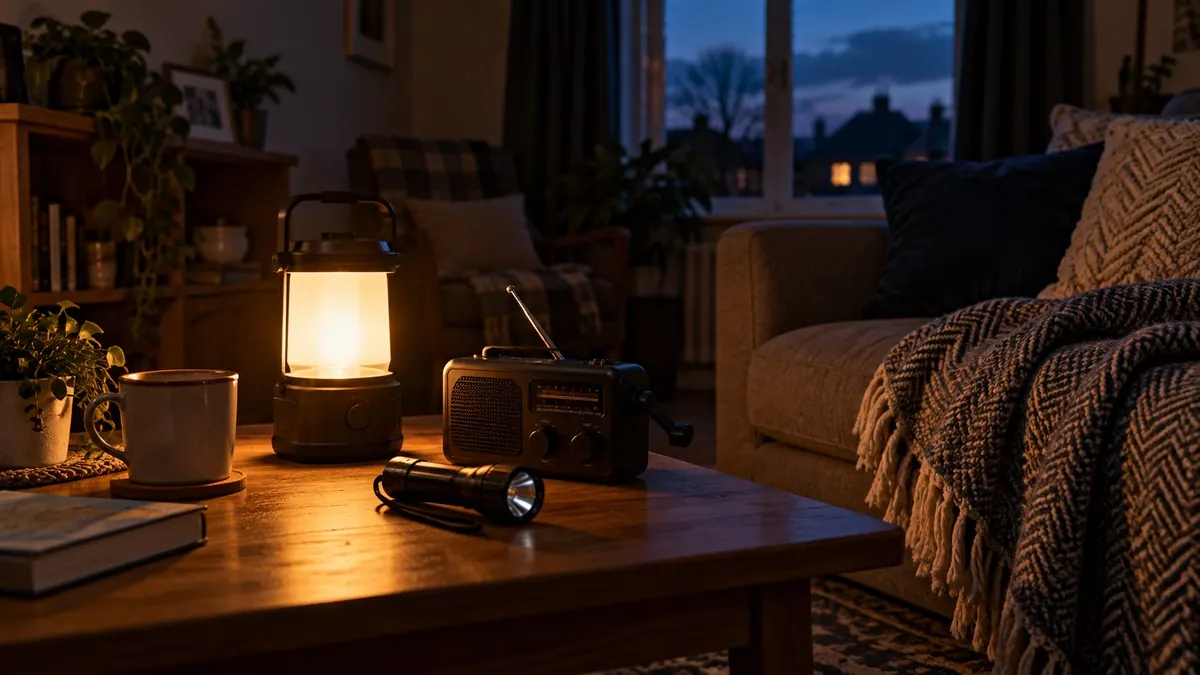
- Torch or battery lantern
- Spare batteries for the torch and radio
- Battery or wind-up radio
- Charged power bank and phone cable
- Bottled water: work out how much with the water calculator
- Food that doesn't need cooking, and a manual tin opener
- First aid kit
- Some cash
- Warm clothes and blankets
Around the home:
- Find your fuse box (consumer unit) and check you can reach it in the dark
- Check your gas hob's manual to see whether it can be lit by hand
- Find the manual release on any electric garage door or gates
- Test your smoke and carbon monoxide alarms
- Write key phone numbers on paper, and fill in a household emergency plan
If someone needs extra help:
- Join the Priority Services Register through your energy supplier or network operator. It's free.
- Ask your medical equipment supplier or GP about a backup plan, and write it down
- Ask your telecare or phone provider what happens to an alarm or landline in a power cut
- Keep prescription medicines, ready-made formula or pet food with your kit, as needed
In the first hour
- Check your fuse box for a tripped switch and see whether neighbours have power.
- If it's not just you, call 105 or check your network operator's website.
- Use torches or battery lanterns, not candles.
- Switch off hobs, heaters, irons and anything else that could be dangerous if it came back on unattended. Leave one light on.
- Keep the fridge and freezer doors closed.
- Check on neighbours who may need help.
If it goes on longer
- Keep warm in one room: close doors and curtains, wear layers, use blankets
- Put phones on low-power mode and top up from the power bank
- Listen to local radio for updates
- Eat food that doesn't need cooking
- Drink stored water if the water supply is affected too
When the power comes back
- Switch appliances back on one at a time
- Check the Food Standards Agency's advice before eating chilled or frozen food
- Reset clocks and timers, including the heating
- Recharge the power bank and replace anything you used from your kit
Print this checklist
Use your browser's print option to print this page or save it as a PDF. For a one-page plan with your own household's details, use the household power cut plan.
When to get help
- Anyone in danger: call 999.
- Worried about someone's health: call NHS 111.
- The power cut: call 105.
- Medical equipment: contact your equipment supplier.
This is a general checklist based on official advice. Your own home may need more or less: the household plan shows what applies to you.
FAQs
What should be in a power cut kit?
A torch, spare batteries, a battery or wind-up radio, a charged power bank, water, food that doesn't need cooking, a first aid kit and some cash. Some of it may already be in the house.
Should I unplug everything?
Switch off anything that could be dangerous if it came back on while you're not there, such as hobs, heaters and irons. Leave one light on so you know when the power is back.
Do I need a separate kit for power cuts?
No. The same home kit covers power cuts, storms and the water going off. Keep it together in one cupboard.
Should I keep candles for a power cut?
Official advice is to use torches or battery lanterns rather than candles.
Related guides
- Power cut: what to doWhat to do in a power cut, calmly: check if it's just you, who to call, what to switch off, and how to keep warm, fed and in touch. Based on official UK advice.
- Does a gas boiler work in a power cut?Most gas boilers stop in a power cut because their controls and pump need electricity. What that means for heating and hot water, and how to keep warm.
Sources
- Which heating works in a power cut (National Grid), awaiting check
- What to do in a power cut (network operators) (Power Cut 105), awaiting check
- gov.uk Prepare power cut advice (gov.uk Prepare), awaiting check
- Digital landlines and power cuts (Ofcom), awaiting check
- Food safety in a power cut (Food Standards Agency), awaiting check
- gov.uk Prepare emergency kit list (gov.uk Prepare), awaiting check
- Who the Priority Services Register is for (Priority Services Register), awaiting check
- gov.uk Prepare household emergency plan (gov.uk Prepare), awaiting check
- British Red Cross emergency kit list (British Red Cross), awaiting check
- Power cut helpline (Great Britain) (Power Cut 105), awaiting check
- Emergency services (NHS), awaiting check
- NHS non-emergency help (NHS), awaiting check