Storing water at home
Sources awaiting check
Emergency water storage calculator
Worked example
For 4 people for 3 days:
- Minimum to drink: 30 to 36 litres (2.5 to 3 litres per person per day).
- Comfortable, for drinking, cooking and washing: 120 litres (10 litres per person per day).
- That's 24 five-litre bottles, or the same in bigger containers.
Source: gov.uk Prepare, awaiting check; NHS, awaiting check; British Red Cross, awaiting check
This guide is for anyone who wants to keep some water at home in case the supply stops or isn't safe to drink for a while. It covers what to store it in, how to fill and label it, where to keep it, and how to keep it fresh.
If you haven't worked out how much you need yet, start with the calculator above or our guide to how much water to store.
The short answer
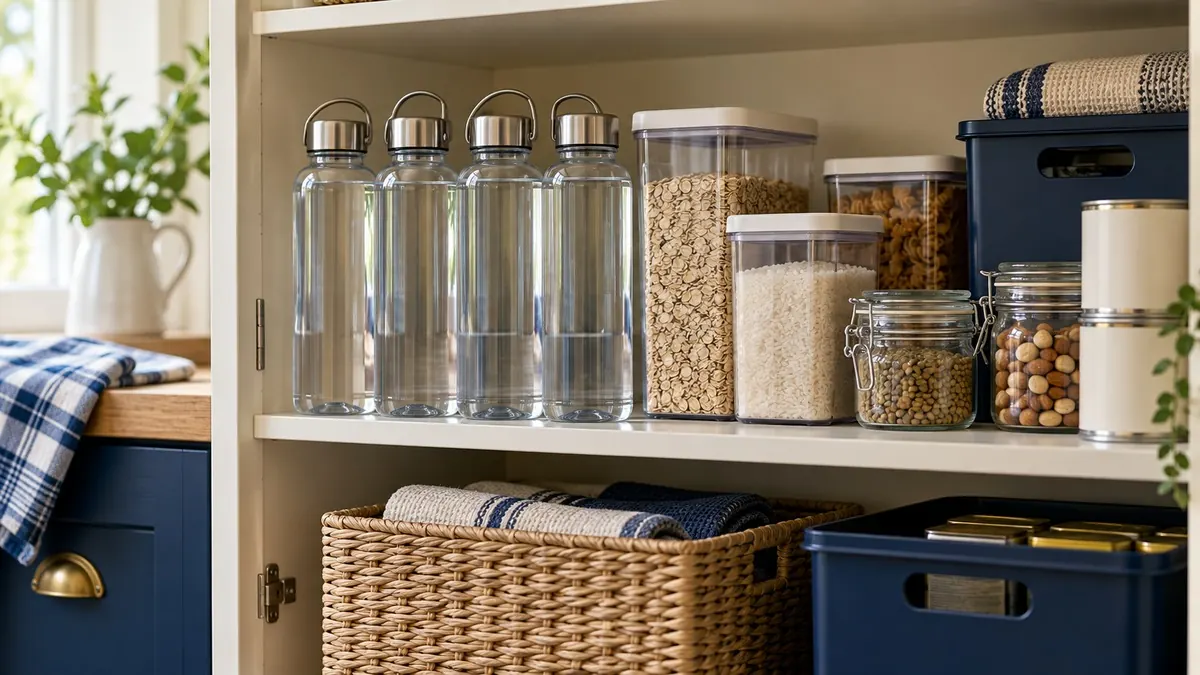
- Use clean, food-grade containers with lids that seal.
- Label each one with the date you filled it.
- Keep them somewhere cool and dark, away from chemicals.
- Use your stored water and replace it from time to time, so it stays fresh.
You can store tap water yourself, or buy bottled water. Both are fine for an emergency supply.
Choosing containers
Look for containers that are:
- food-grade, meaning made to hold drinking water or food
- sealable, with a lid or cap that closes tightly
- a size you can carry, so you can lift and pour it when you need it
Bottled water Ad See water storage container on Amazon
Several smaller containers are easier to move and pour than one large one, and if one leaks you don't lose everything.
Filling and labelling
- Wash the container and lid, rinse them well and let them drain.
- Fill it from your cold kitchen tap.
- Close the lid tightly.
- Write the date you filled it on a label or on the container.
If you buy bottled water, check the best-before date on the label and keep the bottles sealed until you need them.
Where to keep it
- Somewhere cool and dark, such as a cupboard, under the stairs or under a bed.
- Away from chemicals, cleaning products, paint and fuel.
- Somewhere you can reach easily, and where others at home know to look.
Avoid places that get very warm, or very cold in winter.
Keeping it fresh
We don't have an official figure for how often to replace stored tap water yet, so we don't give one. Until we do:
- check the dates on your labels and bottles now and then
- use the oldest water first, for drinking, cooking or watering plants, and refill or replace it
- replace any container that leaks, cracks or looks dirty
Bottled water comes with a best-before date, which makes it easy to keep track.
Household needs
Limited space. Small bottles fit into gaps in cupboards and drawers. Spread them around if you need to.
If you can't lift heavy containers. Choose smaller bottles. Keep them at a height you can reach without bending or climbing.
Babies on formula. Keep some ready-made formula too, because it doesn't need boiled water. See the NHS for advice on feeding.
When to get help
- If your water supply stops, or the water looks or smells unusual, contact your water company. It will tell you what to do and where to get water.
- If you're not sure whether water is safe to drink, don't drink it until you've checked with your water company.
- If anyone is in immediate danger, call 999.
This guide covers storing clean water from your tap or bottled water. It can't tell you whether water from any other source is safe to drink.
FAQs
Should I store tap water or bottled water?
Either is fine for an emergency supply. Tap water is cheaper; bottled water comes sealed with a best-before date.
Can I use old drinks bottles to store water?
Choose containers made for drinking water, with lids that seal. Bottles that held other drinks can be hard to clean thoroughly.
How often should I replace stored water?
We don't have an official figure for this yet. Date your containers, use the oldest first, and replace them regularly. Bottled water has a best-before date to go by.
Can I store water in a garage or shed?
It's best kept somewhere cool, dark and away from fuel, paint and chemicals, which are often kept in garages and sheds. A cupboard indoors is usually easier.
Can I use rainwater or water from a water butt for drinking?
Don't drink it. Store tap water or bottled water for drinking instead.
What should I do if I'm not sure whether water is safe to drink?
Don't drink it. Use your stored water and contact your water company for advice.
Related guides
- How much water to storeHow much emergency water to keep per person per day, using the official UK minimum and comfortable amounts, and how to store it. With a calculator.
- Emergency food listWhat food to keep at home for an emergency: no-cook tins, dry food and long-life drinks from your normal cupboard. Official UK advice, with a planner.
Sources
- Minimum drinking water per person per day (lower end) (gov.uk Prepare), awaiting check
- Minimum drinking water per person per day (upper end) (gov.uk Prepare), awaiting check
- Comfortable water per person per day (drinking, cooking, washing) (gov.uk Prepare), awaiting check
- Days of supplies to keep at home (gov.uk Prepare), awaiting check
- How often to replace stored tap water (gov.uk Prepare), awaiting check
- Extra water for a baby on powdered formula (NHS), awaiting check
- Extra water per pet (British Red Cross), awaiting check
- gov.uk Prepare emergency kit list (gov.uk Prepare), awaiting check
- Emergency services (NHS), awaiting check
- Storing water safely at home (gov.uk Prepare), awaiting check